Learn
Public Adjuster vs. Roofing Contractor: Who Should You Call?
Your claim is going sideways and someone suggests a public adjuster. Your roofer says he can handle it. Who's right? The honest breakdown of what each one actually does — and what each one costs you.
First, the Roles Are Different
The confusion is understandable, because both a public adjuster and a good roofing contractor will talk to your insurance company on your behalf. But they're doing fundamentally different jobs — and mixing them up is how homeowners end up paying for help they didn't need, or going without help they did.
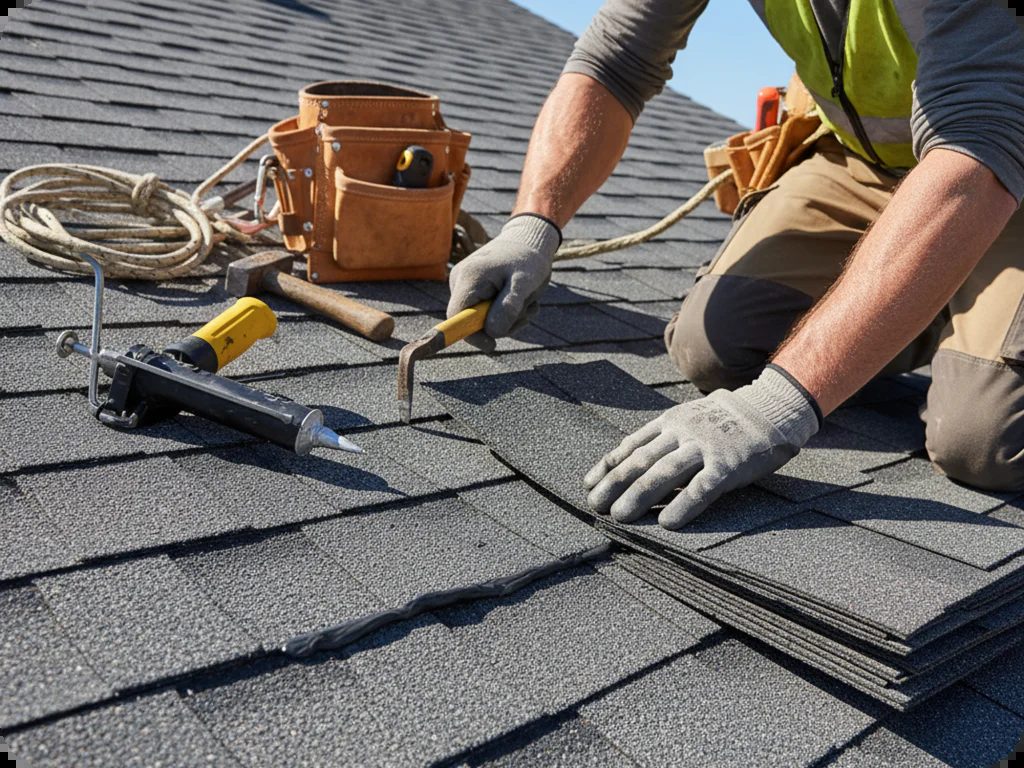
A roofing contractor repairs or replaces your roof. A contractor experienced with insurance work will also document damage, meet the adjuster on the roof, and file supplements for missing scope. Their compensation is the roofing job itself — they get paid when the roof gets done.
A public adjuster is a licensed professional who represents you (not the insurance company) in the claim process. They document the loss, prepare the estimate, negotiate with the carrier, and handle the paperwork. Their compensation is typically a percentage of your final settlement — commonly 10% to 15%, sometimes more on small claims. On a $20,000 settlement, that's $2,000 to $3,000 off the top.
Notice the difference in incentives: the contractor wants the job done at a fair price; the public adjuster wants the settlement number as high as possible, because their fee scales with it. Neither incentive is bad — but you should understand both before choosing.
When Your Roofing Contractor Is Enough
For most straightforward roof claims, a competent insurance-experienced contractor covers everything you need:
- Damage documentation. Photos, measurements, test squares, collateral damage — the evidence package the claim rests on.
- Adjuster meeting. A good contractor attends the inspection and points out damage the adjuster might miss. This alone changes outcomes regularly.
- Supplements. When the carrier's estimate misses line items — drip edge, flashing, code upgrades, steep charges — the contractor files supplements to add them. This is routine, expected claim work.
- Completion paperwork. Final invoices and photos that release your recoverable depreciation.
If your claim was approved and the fight is about scope and price — missing line items, low pricing, a shortfall between the estimate and real cost — your contractor is the right weapon. That's a documentation and negotiation problem inside a functioning claim, and it's exactly what experienced roofers do every week. Before your adjuster visit, read how to prepare for the adjuster so the inspection itself goes right.
When a Public Adjuster Earns Their Fee
There are situations where a contractor — even a great one — isn't the right tool:
Large, complex, or disputed losses
Multi-structure damage, interior damage plus roof damage, commercial properties, or claims where the carrier's position and reality are far apart. Public adjusters live in claim documentation full-time; on a big messy file, that specialization pays.
Denied claims you can't crack yourself
If you've been through reinspection and escalation and the carrier won't move, a public adjuster brings a fresh, professional claim presentation — new documentation, new estimate, formal negotiation. Sometimes a new voice with credentials resets a stalled file.
You can't or won't manage the process
Claims take dozens of hours: calls, emails, documentation, follow-ups, deadlines. If you genuinely don't have the time or temperament, paying a percentage to hand the whole thing to a professional can be rational — just make sure the math works (see below).
Do the Math Before You Sign
A public adjuster's fee comes out of your settlement — money that would otherwise go toward your roof. Run the numbers honestly:
Say your carrier offered $12,000 and you believe the claim is worth $18,000. A public adjuster at 10% who gets you the full $18,000 costs $1,800 — you net $16,200, which is $4,200 better than the original offer. Good deal. But if the adjuster only moves it to $13,500, their $1,350 fee leaves you at $12,150 — barely ahead of where you started, and you've lost weeks.
Also check your state's rules. Public adjusters are licensed and regulated differently in every state: fee caps, contract cancellation periods, and licensing requirements all vary. Never sign a public adjuster contract without understanding the cancellation window — reputable ones disclose it upfront. And be wary of anyone who solicits you door-to-door right after a storm; the reputable firms don't need to chase hail.
One more caution: some contractors will suggest you hire "their" public adjuster, or a public adjuster will arrive with a preferred contractor attached. Referral relationships aren't automatically corrupt, but you should know when one exists. You're hiring professionals to protect your interests — make sure you know whose interests are actually being served.
The Third Option: Handle It Yourself
Here's what nobody selling you services will tell you: many roof claims are entirely manageable by an organized homeowner with the right information. The claim process is a sequence — document, file, meet the adjuster, review the estimate, supplement what's missing, complete the work, collect depreciation. Each step is learnable, and the carrier is required to deal with you directly whether or not you have representation.
The homeowners who get the worst outcomes aren't the ones without a public adjuster — they're the ones who don't understand the process at all: who cash the first check without reading the estimate, who miss the supplement window, who never collect their recoverable depreciation. If you understand the game, you can play it. If the claim later turns genuinely adversarial — a bad-faith denial, a six-figure dispute — that's when professional help earns its fee, and you'll know it when you see it.
And if the dispute is about the dollar amount rather than coverage, remember the appraisal clause in most policies: each side hires an appraiser, and the process resolves valuation fights without anyone taking a percentage of your settlement. Our appraisal guide explains when that tool fits.
Learn to run your own claim first
The Roof Claim Playbook ($27) gives you the full process — what to document, what to say to the adjuster, how to read the estimate, when to supplement, and how to escalate. Most homeowners who understand the sequence never need to give away 10% of their settlement.